
Charles Flint and his mother Jane appeared in a previous post, ‘Death of a Penrith Crimean War veteran’
Charles Flint had found veteran Thomas Fenton ‘a light occupation’ and Fenton had been a lodger at Jane Flint’s house in Pattinson’s Court, Penrith, for many years. He actually died there, in 1897.
It was while writing up that post I realised two things.
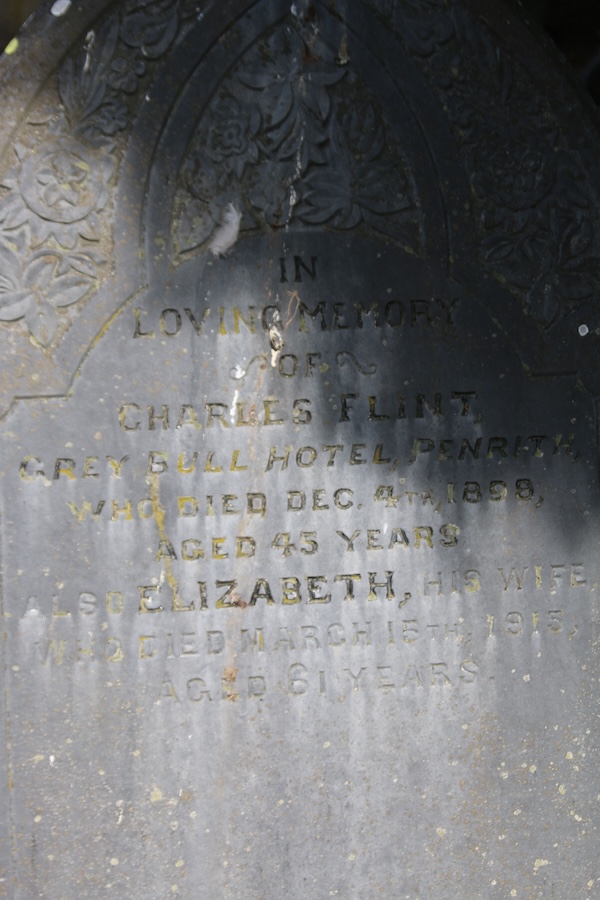
Firstly, I’d taken a photo of Charles Flint’s headstone, at Beacon Edge Cemetery, a few years ago.
Secondly, one of Jane Flint’s lodgers, in 1881, was a woman called Mary Pears, then 71 and described as a ‘land surveyor’s wife’. Not a relation, but a woman whose name I know well as she has quite a story attached to her.
There’s also a sort of symmetry, in that Mary was was ‘Mary Taylor, of the Grey Bull Inn, Penrith’ when she married John Pears in 1836.
In about 1895, Charles Flint became landlord of the Grey Bull.
Jane Flint
Charles’ mother Jane was née Jane Wilson. In 1845, she married, in Penrith, a man called Robert Flint who hailed from Deepen, in Norfolk.
He was a labourer, who had no real ‘connection’ to Cumbria, which turned out ill for Jane.
The 1851 census shows Robert, then 29, and Jane, 26, in lodgings in Millom.
With them were children Jermany aged four, Joseph two, and Elizabeth, 10 months.
Sadly, young Jermany (named for a Flint relation in Norfolk) died later that year. He is recorded as Jeremy, son of Robert Flint, railway labourer, and died at Ulverston.
Robert went where there was work, it would seem.
Little Elizabeth died in 1852.
More children followed, all registered in the Penrith district: Charles in 1853, Robert in 1855, Sarah Elizabeth in 1857, and John Wilson Flint in 1860 (with the mother’s maiden name not listed).
Again, sadly, Sarah and John both died at the age of one.
By then, their father seems to have been history.
The 1861 census has Jane Flint at Townhead, listed as a charwoman and married. With her are Joseph, 12, Charles 7, Robert 5, John Wilson, 11 months, and a female boarder.
Of Robert Flint, there is no sign.
Online family trees and their sources aren’t the best source of information, but if they are correct, in 1861, Robert Flint married again – under the name of Robert Smith, in Scotland.
If that’s the same man, his first wife Jane was very much still alive.
Said trees also show him accused of fathering a child by a married woman in 1885 – his first and second wives both still being alive.
If he was living as Robert Smith, in 1871, he was alive and living in Glasgow with a wife 13 years younger than him and three children; the eldest only 18 years younger than her mother.
But then Robert Smith was 40, so born about 1831, whereas 20 years earlier Robert Flint was 29. so either he’d knocked nine years off his age when he changed his name and married a teenager, or it’s not him.
In 1871, at Pattinson’s Court, Jane Flint was claiming to be a widow. And the charwoman was now calling herself a midwife – obstetrics then being a role ‘any woman could do,’ rather than one requiring years of medical training.
With her was Thomas Fenton of the ‘Crimean War veteran’ post, listed as 46 (sic), boarder, and Greenside Mines labourer.
Jane was still at Pattinson’s Court in 1881, only for some reason the enumerator swapped things around and had Thomas Fenton as the head of house and Jane as HIS boarder.
With them were Mary Pears, plus John J Smith, 13, nurse child.
‘Nurse child’ usually refers to an infant. Either John J Smith was an orphan, or illegitimate and left with Jane by his mother so she could work or marry.
For sure, John J Smith was still living with Jane Flint ten years later, confusingly aged 20.
And he’s still with her in 1901, John Joseph Smith, 32.
There IS a John Joseph Smith registered in 1869. He was the son of Isabella Smith of Watermillock, born January 19 in Little Dockray, Penrith.
An Isabella Smith married stonemason Edward Hindson in 1872 and died in 1879, aged just 28, leaving him with three young children.
Jane Flint looks to have died in 1911, her age given as 84 on the register. A death notice in the Cumberland & Westmorland Herald says she died on March 31, aged 85.
John J Smith married at the end of that year. As did Jane’s grandson Joseph Flint, son of her son Joseph. He was to be killed in action in Flanders in November 1914, but that’s another story.
Charles Flint
Jane’s son Charles was a clogger, boot and shoemaker with a business at Stricklandgate, Penrith, where he and wife Elizabeth (née Richardson), show up on the 1891 census, with children John, 17, and Mary E, 11.
But by 1892 (for sure) Charles had also taken on the Stoneybeck Inn, at Bowscar (on the A6 north of Penrith). And at 39, he was seriously overweight.
‘1892. May 28. Charles Flint, clogger and innkeeper of the Stoney Beck, near Penrith, a very stout man, was charged with being drunk and disorderly in his own house on the 19th.’
The short version is that two police officers found him asleep in a chair in the Stoneybeck. When they managed to wake him:
‘Flint followed them to the door and staggered several times against the partitions.’
But Charles Flint himself, along with James Sloe; Penrith clogger George Lendrum; and Thomas Fenton, a lodger at Stoney Beck, swore that Flint was sober.
His defending solicitor said he wasn’t drunk, but suffering from obesity:
‘One of the results of this fatness was that like Dickens’s fat boy, he dropped off to sleep in an instant and it was almost impossible to awaken him.’
Dr Tristram Lowther Montgomery, of Wordsworth House, Penrith, backed this up:
‘Dr. Montgomery deposed that he had attended defendant who was suffering from fatty heart and liver, and obstruction in his lungs, which tended to produce very heavy sleep. He had seen him tumble asleep in his surgery, whilst ho was making up his medicine, and even when he had been talking to him in his clogger’s shop he had gone over, at such times he could be heard snoring to a considerable distance.’
The Bench decided to give defendant the benefit of the doubt, and dismissed the case.
Charles Flint also appears a few times in news stories: disputes over soles, and potatoes, for instance, and a dog worrying chickens. He was also ‘well-known as a poultry fancier’
He was still landlord of the Stoney Beck in September 1895, but by November that year was at the Grey Bull.
Charles Flint died at the Grey Bull in December 1898, aged 45.