
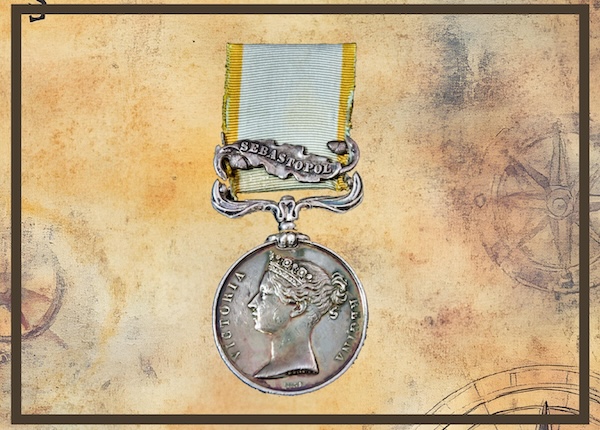
Thomas Fenton.
Death of a Penrith Crimean War veteran
Penrith Observer, May 11, 1897:
‘We have to record the death of Mr. Thomas Fenton, Scotland Road, Penrith, at the age of 68 years. Deceased, when in the Artillery, went through the Crimean War in 1856…’
The Crimean War
‘The Crimean War (1853-56) is mostly remembered for three things: the Charge of the Light Brigade, mismanagement in the British army and Florence Nightingale. ‘
So says the Florence Nightingale Museum, in London. And while it is clearly partisan on the topic, it seems a pretty fair summary to me.
To be honest, all I know of otherwise is the place names. Which like ‘Mafeking’ (from the Boer War) and of course ‘Waterloo’ and ‘Trafalgar’ were later given to roads and pubs and railway stations and squares to celebrate victories.
Oh, and headgear. The famous Crimean War places being Alma, Sebastopol… and Balaclava.
The Crimean War saw France, Britain and the Ottoman Empire lined up against Russia.
The siege of Sevastopol (Sebastopol) lasted from October 1854 until September 1855, and was all about the allies trying to capture a key naval base, home to the Russian Black Sea fleet.
According to various sources, both sides lost more than 250,000 soldiers (each). And a lot of those deaths were down to disease rather than military action.
Thomas Fenton survived both.
Thomas Fenton at war
According to the obituary in the Penrith Observer:
‘He was shot in the neck and leg during the campaign, and obtained three medals.
He used to delight to tell his military experiences at Sebastopol and elsewhere, but latterly was somewhat reluctant about entering into any discussion on the memorable battle.’
Without paying yet more subscriptions, I haven’t got access to Crimean War records. We can only guess at Thomas Fenton’s experience from general articles about the war, and from the obituary information.
Presumably he had the medals – and scars – to show people in the days when he ‘delighted to tell his military experiences’.
Why he went from that to reluctance to talk about it is anyone’s guess, and it would be unfair to speculate.
Thomas Fenton in peace
The obituary continues:
‘He was for thirty years a lead miner at Greenside Mines, Patterdale, and for many years walked to and from Patterdale to Penrith every weekend; it appeared no trouble to him when over three-score years to perform the journey of fifteen miles.
Latterly Mr. Charles Flint, Grey Bull Hotel, Penrith found him a light occupation, and he passed away at the house of Mr. Flint’s mother, after a fortnight’s illness.
The old man’s bent form will be missed in the Townhead district, where he was much respected. He was unmarried. His remains were interred in the Churchyard at Newton Reigny on Thursday, the rector officiating.’
FindaGrave doesn’t have a photo of any headstone.
Rewind
What we can find on Thomas Fenton elsewhere is also somewhat limited. Even his age is in dispute, possibly because census returns were filled in by people he was lodging with who didn’t know for sure.
1897. December. At Pattinson’s Court, Penrith, on the 3rd inst, Thomas Fenton, aged 68 years.
Which puts his birth at 1829. Later census records say he was born in Penrith.
The only readily available records for the birth of a Thomas Fenton are an 1825 St Andrew’s, Penrith baptism. Both January 14, but one ‘mother Rachel Fenton’; one ‘mother Barbara Fenton’. And both, well, 1825.
The 1841 census has a Thomas Fenton, male servant, at Plumpton, aged 14. So born approximately 1827.
In 1861, he is lodging in Patterdale, occupation labourer, aged 30. So born about 1830/31.
In 1871, he’s boarding with Charles Flint’s mother, Jane, at Pattinson’s Court, Penrith. Listed as a Greenside Mines labourer, his age is given as 46. So born 1824/25.
Still there ten years later, he is 55, so born 1825/26.
In 1891, on census night, he was back in Patterdale, at Patterdale Smelt Mill: Thos Fenton, 63 (sic), lead smelter, lodger with a family called Kirkup. So born 1827/28.
What jumps out is that he doesn’t show on the 1851 census. Which fits him being off with the Army somewhere overseas: even searches such as: ‘Thomas… Artillery’ don’t find him in the UK.
The only other news stories that fit Thomas Fenton date from 1859, three years after the Crimean War ended when he had left the Army and sufficiently recovered from his wounds to work as a miner at Patterdale.
Sadly, it’s the story of how he and a fellow workman called James McGarr stole a half sovereign (10 shillings) and three shillings from a mantlepiece in someone’s home.
They’d been invited into the house by workmate John Rigg. It was his mother and stepfather’s house (John and Jane Brumbwell). Money had been brought by the postman the day before, from a sick club at Penrith, and placed on the mantelpiece by Mrs Brumbwell.
Thomas Fenton and James McGarr, both pleaded not guilty, but were convicted and sentenced to four months in prison, with hard labour. Again, it would be wrong to speculate about the full facts of the theft.
All we can say is Thomas went back to Patterdale after serving his time, and was lodging at the Smelt Mill, part of the Greenside Lead Mines. Not only were the Brumbwell family still living in Patterdale, but John Rigg, his stepfather and two stepbrothers were working in the lead mines.
- You can read more about Charles Flint and his mother in this post.