
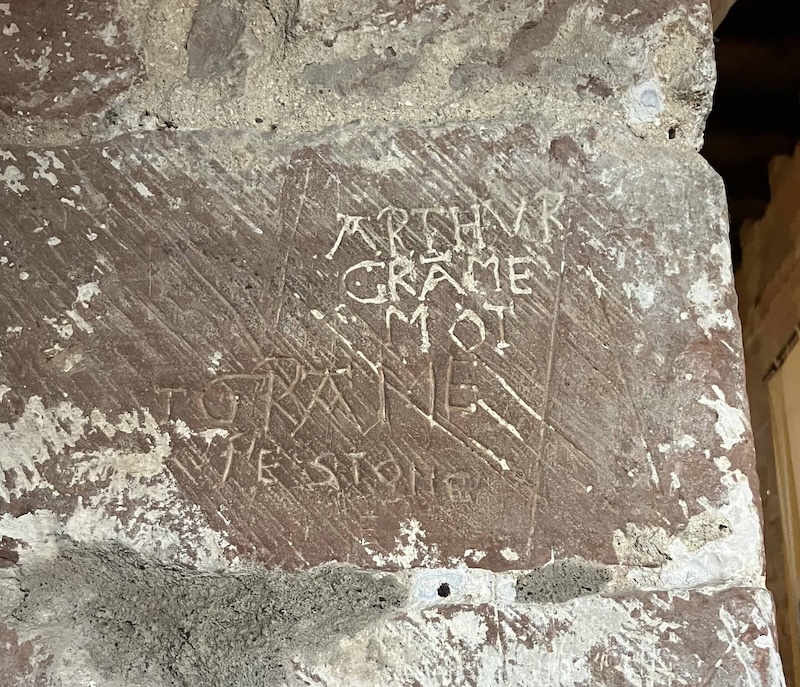
Carlisle Castle graffiti, for most people, means the amazing pictures carved into the keep walls circa 1542 of heraldic symbols and strange animals and a knight’s head (I gather the armour gives the date).
But impressive though those are, for me, there’s a far more incredible set of scratchings in the wall of Carlisle Castle keep.
And I also disagree (politely) with someone else’s interpretation of one of them.
Carlisle Castle graffiti discovered
I don’t know how many times I’ve visited Carlisle Castle. Too many to count, that’s for sure. And yet it wasn’t until recently, when I chanced to visit just as a guided tour was starting (thank you Derek) that I knew about the reiver graffiti.
The guide pointed out a shield carved with the initials TBB and the date 1603. Attracted by the date, if not the name – Thomas Blenkinsopp was from Northumberland – I looked around the corner.
And got goosebumps. A total “Wow!!!” moment. I still get it looking at the photos I took.
For there, carved above (my) head height plain as day, was:
‘ARTHUR GRAME MOT’
And under it, what I read as:
‘T GRAME
‘oF EASTON(
E)’
Though someone else fascinated by the Carlisle Castle graffiti read it as:
’T Graham The Stone’. I’ll come back to that.
Standing in the footsteps of the past
Why the goosebumps? Because when I took them, I was standing where Arthur Graham and Thomas Graham had stood 421 years ago.
Men I’d learned about by researching old documents written by other people, who had otherwise left no trace, had left this of themselves.
I don’t suppose it occurred to them someone in the 21st Century would be looking up at their carvings, or that anyone who did would know their names or care.
But this was like looking at a portrait, even better in a way, as while a portrait shows you what someone looked like, this was the work of the men themselves.
You can’t hope to get or feel a better connection across four centuries than that.
Carlisle Castle graffiti ‘transcribed’
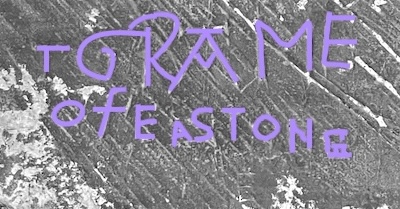
I’ll stick with my reading of the lower name as ‘T GRAME oF EASTONE(E),’ because while the ‘A’ in ‘EASTON’ is small, I can see it. I can also see ‘oF’. But I can’t see ‘THE’ . Whatever is at the end of ‘EASTON’ might well be an E*, but spelling wasn’t exactly regular in those days.
As Arthur ’s ‘Mot’ shows (and ‘Grame’, come to that).
Though I can see how it would look like ‘STONE’, especially from a distance.
The thing is, we are all programmed to see patterns in everything, eg clouds that ‘look like a horse’ or whatever, and to see words we recognise.
And our minds fill in gaps, so I cd wrt a sentnce wth some of the vwls missng and you wd b abl to rd it.
So I saw ‘Easton’ because I know there was a Thomas Graham of Easton.
While the other person saw a word he knew, rather than a place name/person he didn’t.
There is also the fact that in all my research, I’ve never come across anyone (of any surname) with the nickname ‘the stone,’ nor can I think why it would be applied.
Also, why would Thomas Graham have gone to all the effort of carving a nickname when he hadn’t bothered to carve the rest of ‘Thomas’?
It was place names that showed which branch of the grayne you belonged to and that WAS important. Your physical appearance or characteristics (nicknames) weren’t.
*Close up, it looks less like an E, but possibly an E that has been scratched over to change it it into nothing.
“You don’t spell Easton with an E at the end, Thom.”
“Ok, Mr Fussy, I’ll change it, but there’s no delete button, you know.”
There’s another big reason in favour of it being Thomas of Easton.
The Story of the Border Grahams
The following is an extract from my new book, in the chapters on how, after King James VI of Scotland came to the English throne in 1603, many able-bodied Graham men were rounded up and sent to the Low Countries, to the English garrisons there.
It was resolved that Sir Wilfrid Lawson (head of the English border commissioners) would select 149 Grahams for immediate banishment.
His list started with:
‘William of Mote, his brother Arthur; Richard of Netherby; Jock’s Ritchie; All our Eames (John) Graham; Young Hutchin; Geordy’s Sandie; Long Ritchie; Thomas of Easton aka Richie’s Will’s Thom…’
They were summonsed to Carlisle, most went…
They weren’t exactly keen volunteers, so – in 1605 – they were held in Carlisle Castle (from where some of them proved their lack of enthusiasm by escaping).
But they weren’t exactly prisoners either – the authorities wanted them to be in good shape when they got to the overseas garrisons, so chucking them in the ghastly dungeon to survive by licking the walls for water* would have been counter-productive.
Housing them in the big rooms higher up in the keep would have made far more sense.
And as they were likely stuck there a while, with nothing else to do, some of them who were bored (and literate) left their mark for posterity on the walls.
*You can read all about Carlisle Castle on the dedicated English Heritage site
So the Carlisle Castle graffiti is from 1605
So there we have it.
In the summer of 1605, Arthur Graham of Mote, and his second cousin Thomas Graham of Easton would have been held a while in Carlisle Castle, before being transferred to Newcastle and from there to, respectively Brill and Flushing.
Arthur was later to return, and headed out to Ireland in April 1607.
But the online article is, I think, wrong again: he was, technically at least, a volunteer, and not, as the Carlisle Castle graffiti article says, ‘deported’.
It may not have been much of a choice. But as you can read in my book, the garrison town Grahams chose to go to Ireland to be with their families, as a better option than staying in the Netherlands indefinitely without them.
The same probably goes for ‘T Grame’. I don’t have a note for what happened to him after he was sent to Flushing. If he got there, or stayed there.
But to read more on all of that, you’ll have to buy a copy of my book!
Fascinating, thank you. Can’t wait to visit!