
Armed clergy in 1610
The old hymn ‘Onward Christian soldiers,’ written in 1865, may have been figurative. In earlier centuries, it wasn’t.
You only have to think of the stories about the Vikings to be reminded of that.
As English Heritage sums up one very infamous raid:
‘The devastating Viking attack on the church of St Cuthbert in 793 sent a shockwave through Europe.’
Even after the British nations we know today became settled, and the risk of invasion became limited to other Christian nations, it was no guarantee that religious sites would be spared from fire and sword. Either because there was the prospect of ‘rich pickings’ in church plate etc. Or because those with the swords said their prayers differently and regarded those in ‘the cloth’ as heretics.
Being men of God was no protection against those who didn’t respect you/your religion. So while those attacked by the Vikings were men of peace, in a later age, it was realised pacifism wasn’t an option: armed clergy was the solution.
Armed clergy on the border
Particularly at risk were religious sites near (on both sides) of the Anglo-Scottish border. Arthuret Church needed rebuilding by 1609, as Scottish raiders had burned down previous versions. While Canonbie Priory was destroyed under the orders of English commander Lord Wharton as part of the reprisals after the Scots had invaded late in 1542, and ‘justified’ by it being a Catholic house – destroying it was a ‘legitimate’ continuation of Henry VIII’s Dissolution of the (English) monasteries.
Meanwhile, Carlisle Cathedral, for all that it was contained within the city walls, was no safe haven for its clergy.
The cathedral’s own website includes how:
‘During the English Civil War, a portion of the nave of the cathedral was demolished by the Scottish Presbyterian Army in order to use the stone to reinforce Carlisle Castle.’
And I covered, in a previous post:
how a century later, it was used a prison for Jacobite soldiers (who had themselves taken the city a month or so before). And how you can see damage from musket balls in the cathedral walls to this day.
Go back to 1610 – seven years after England and Scotland became united under a single monarch – and centuries of border turbulence were far from over.
Records in Carlisle Archives include, in that year:
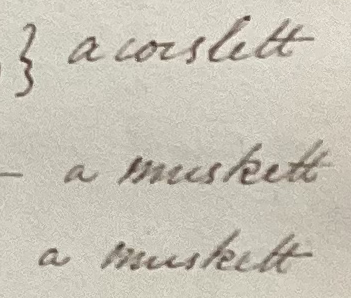
‘a note of the particular assessment of the clergy of this diocese for horse and armoury’.
A corslet was (is) a full set of defensive armour covering the body.
‘Patrouille’ is French for ‘patrol’.
Armed clergy 1610: The list
- The bishop: two light horses
- The dean and chapter: a light horse
In the deanery of Carlisle:
- The two tenants of the rectory of Aikton: a musket
- The parson of Orton, vicar of Brampton: a musket
- The parson and vicar of Arthuret: a patrouille
- The parson of Bewcastle: (I missed the rest of that entry, sorry).
In the deanery of Cumberland
- The parish of Greystoke: a light horse
- The vicar of Addingham, parson of Melmerby: a musket
- The parson of Skelton, vicar of Sowerby: a corslet
- The vicars of Lazonby, Penrith, parson of Croglin: a musket
- The vicars of Kirkland, Edenhall, Ainstable, parson of Hutton: a musket
- The parsons of Kirklinton and Bowness: a musket
- The vicar of Kirkbampton and parson of Castle Carrock: a musket
- The parson and vicars of Scaleby, Irthington, and Stanwix: a musket
In the deanery of Allerdale
- The vicar of Crosthwaite, parson of Caldbeck and the parson of Bolton each had corslets.
- The vicar of Torpenhow, parson of Uldale and the vicar of Bromfield each had a musket.
- The parson of Plumbland and vicar of Bridekirk had a musket between them.
- The vicar of Holm Cultram, parson of Kirkbride and vicar of Aspatria likewise.
In Westmorland, the clergy between them had eight muskets and four corslets.
Pray we don’t need them
By now, you are no doubt thinking ‘fat lot of good that would be’. Those with horses lacked weapons or armour. Those with weapons lacked armour or horses. Those with armour lacked weapons or horses.
Single muskets wouldn’t have provided much security against even a small band of raiders.
And if someone had attacked the parsonage at Croglin, it wouldn’t have been much use if the musket had been in Penrith or Lazonby at the time.