
Rory Stewart’s Middleland book is now out in paperback and, like all his books, well worth reading.
It’s a collection of columns he wrote for the Cumberland and Westmorland Herald during his time as MP for the since-abolished constituency of Penrith and the Border.
If you haven’t yet read it, his title ‘Middleland’ (available for eg Waterstones) is a reminder that Cumbria straddles the Roman barrier of Hadrian’s Wall and for many centuries was an independent kingdom: neither Scottish nor English.
Forward a few centuries and, while powerful and ambitious kings forged a real distinction between Scotland and England, the families living both sides had more in common with each other (including through marriage) than with folk in Edinburgh or London.
When King James united the two countries, he abolished the old administrative areas and called the whole thing ‘the Middle Shires.’
Lost Longtown farms
Rory Stewart’s Middleland book contains a piece on the Longtown munitions factory.
After describing how it enclosed ‘a patch of good farmland almost 12 miles long’ between Annan and Longtown, Rory ponders:
‘The original farmers may have been descendants of border-reiving Maxwells and Johnstones; perhaps they had even been around when the Middleland was an independent nation.’
He says their story ended in 1915, but he’d not been able to trace where they went.
Happy to help!
Forget the Maxwells and Johnstones. Go back to reiver times and the lost Longtown farms were the territory of the Grahams.
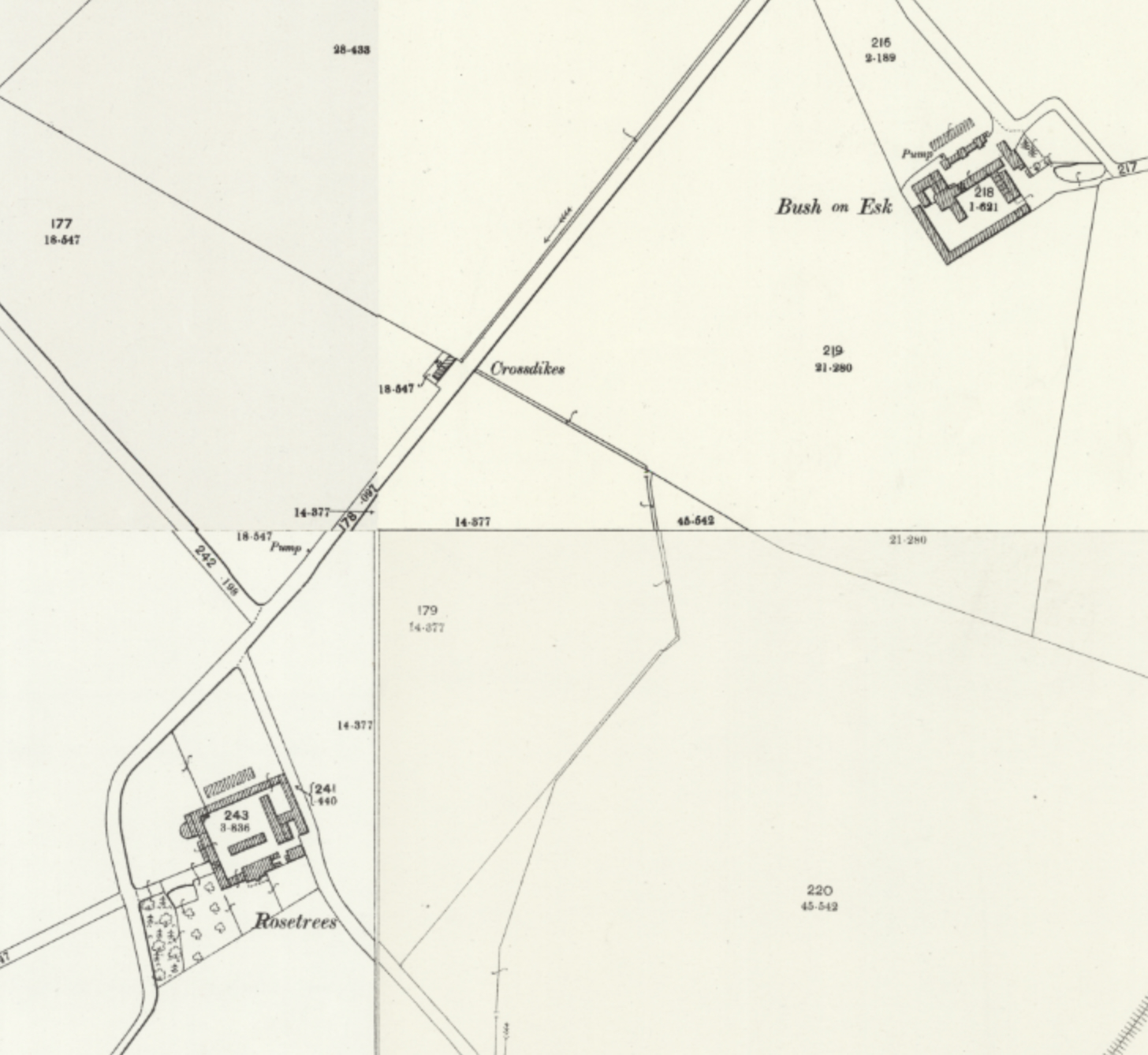
Slap bang in the middle of the munitions site was Rosetrees.
Rosetrees
A 1552 map has ‘Rosetrode Mosse’ but no buildings. The moss shows on recent maps as a large wooded area.
But by 1561, there are references in documents to William Graham of Rosetrees.
He was the son of William Graham of Carlisle, who in turn was the son of Lang Will Graham.
You can read all about them in my book, The Story of the Border Grahams, chiefest actors in the spoil, available to buy here.
Jumping forward to 1851, and Rosetrees was owned by Frederic Ulric Graham of Netherby
As was Bush on Esk.
Bush on Esk
Look at a pre-munitions factory map and you’ll see another farm that was swallowed up by the site: Bush on Esk.
Who lived there?
After King James did his best to eradicate the Grahams from the borders, we eventually lose track of the Grahams of Rosetrees. They were to be ‘removed’ to ‘some place in England or Scotland not part of the late borders.’
But after Richard Graham of the Plomp line earned fame and fortune later in the 1600s, Rosetrees and Bush on Esk became Graham properties. Rented out as very large (acreage) farms.
Rosetrees more recently
By 1680, Rosetrees was tenanted by a family called Stockbridge. By 1710, there were Irvings there. And through the 18th century, it went from Johnstons to Coulthards to Heslops.
By 1860, there was family called Gibbons at Rosetrees Farm (there was also a Rosetrees Cottage). The 1861 census shows widowed Mary Ann Gibbons, at just 38, with five children aged 11 down to four, was running a farm of 500 acres and employing 12 labourers and one boy. She also had a female house servant and a dairymaid.
Mary Ann was still making a go of Rosetrees in1871, but sadly she died there the following year, aged 50.
In 1881, Rosetrees was being farmed by a Graham! Namely John Graham, who was 46 and had been born in Newbiggin, Westmorland.
The Grahams (John and Ann) were still there in 1891, now with 10 children. At some point (for sure by 1911), they moved to Cardew Hall Farm, Dalston.
In 1901, Rosetrees was being farmed by Francis Tinning, 47, with his wife Mary, 32. They had two infant daughters a visitor, three farm servants, and Francis’ uncle William Tinning, 77, was living with them.
They were still there in 1911, four years before the War Office commandeered the area.
Bush on Esk more recently
Less easy to find, information-wise, it does show up in 1750 as the home of Edward Atkinson, gentleman.
In 1861, Bush on Esk shows as four households. The main family were all Scottish-born: James Campbell, 35, wife Janet, 37, and their four children, aged 14 down to one year old.
James Campbell dies in 1877.
The 1881 census is a puzzle. It shows, at Smalmstown, James Tinning, 50, farmer of 670 acres, children Thomas 25, Walter 23, Jane 21, James 14 and John 9. And ‘see schedule 4’
Crucially, a few pages earlier on 1881, we find ANOTHER James and Margaret Tinning, farming 1,160 acres and for sure the parents of Francis, who was to take over Rosetrees. With them are Robert 28, Francis 26, Maggie 18, William 15, Mary 12, and Sybil 6.
Except rewind to 1871, Mosside Farm, and it’s James and Margaret with Robert 18, Francis 17, Thomas 15, Walter 13, Jane 11, Margaret 9, William 6, James 4 and Mary 2.
So 1891 is the same James – at two farms, with his children split between the two and wife Margaret at the ‘other one’.
Smalmstown was part of the Netherby estate and the two farms were neighbours, though the actual farmhouses were a good distance apart.
The key thing to all this is that James and Margaret’s son Francis Tinning is the one who went on to farm Rosetrees.
James Tinning died in 1890, and in 1891, Bush on Esk was being farmed by widowed Margaret Tinning – the mother of Francis above. With her were five children: Margaret 30; James 22; Mary 20; John 18, and; Sybil 16.
1901 shows Margaret, 71, as head, with son James 33.
By now, poor John was in a psychiatric institution in Dumfries. He died there in May 1915, his probate address still showing as Bush on Esk.
Margaret died there on February 3, 1908. Son James had died just two months before – accidentally drowned in the River Esk while crossing it in a pony and trap, on the way to visit his brother William, of Burnfoot Farm.
The 1911 census shows there were nine principal rooms, occupied by widowed Margaret Scoone, 48; her married sister Sybil Tate, 36; a Tate nephew and niece (Robert Cecil Tate, 8, Constance Sybil Tate, 5). And two other nephews, James Tinning 16, and Francis Tinning, 14, who are listed as ‘farmer assisting’.
Both Margaret and Sybil were née Tinning: daughters of James and Margaret, and sisters of Francis and John.
Margaret had married James Scoone in 1897, only to be widowed in 1899. She stayed at his farm in Canonbie for a while, but at some point, I’d guess not long after 19011, returned home to Bush on Esk.
So where DID they go?
According to the 1921 census, not very far.
Francis and Mary Tinning were at Mossband Hall, Gretna. Across the railway line from Rosetrees Moss.
Margaret Scoone, in 1921, was living on her own at Esk Bank, in Longtown.
Footnote:
The image is from TheGenealogist.co.uk, where you can use a slider to see how the two lost Longtown farms were subsumed by the munitions site. You can also trace their footprint on the Lidar map.