
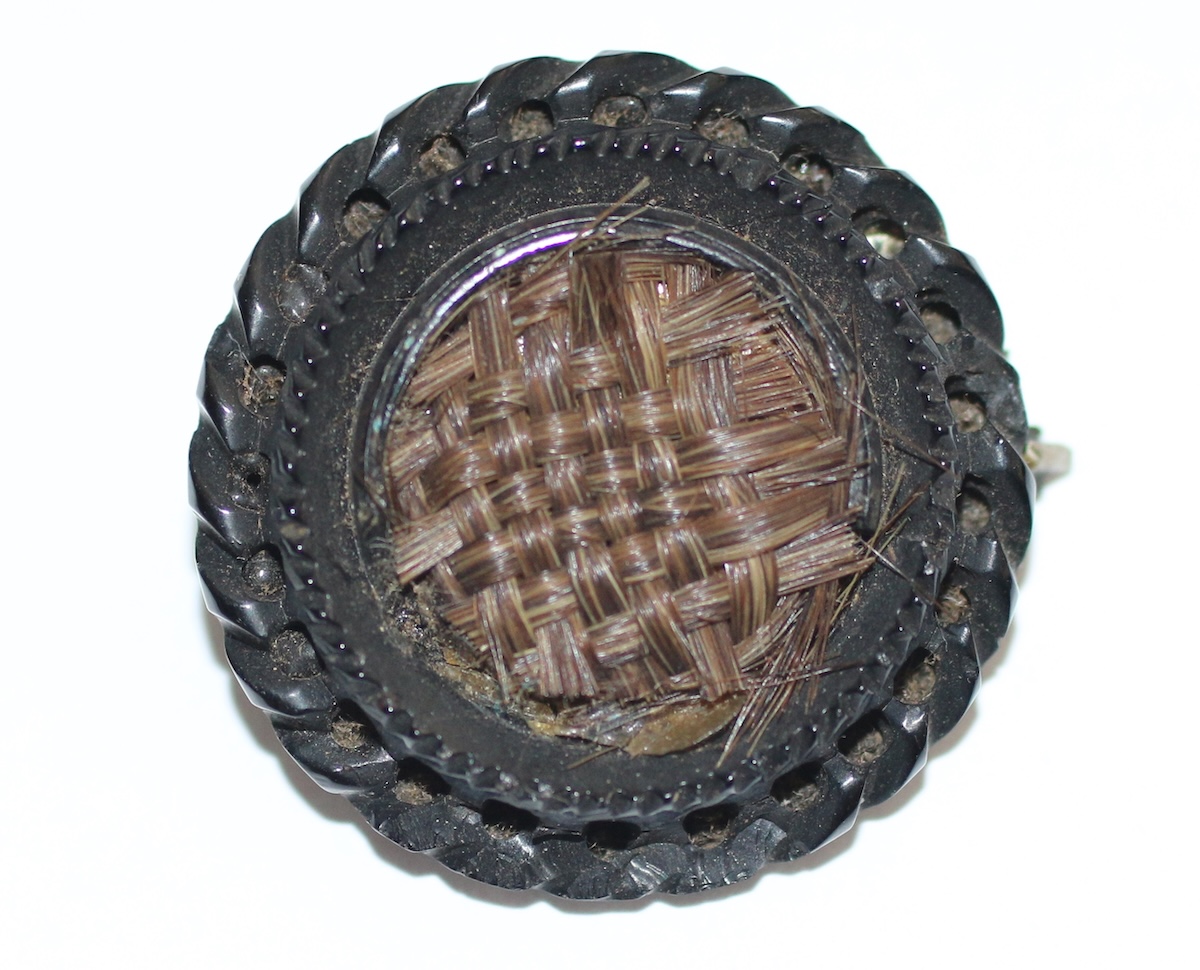
Mourning jewellery has a longer history than you might think. I, for one, thought of it as a Victorian thing. And a bit weird at times.
For sure, the mourning jewellery I have inherited (pictured) seems bizarre as it comprises a jet brooch with woven hair in the centre.
Whose hair, I have no idea. Some relative on my maternal (mother’s mother’s mother’s mother) line, has to be, given how I ended up with it. But whether my GG grandmother wore it herself or inherited it, is anyone’s guess. Let alone whose hair was snipped off – presumably post-mortem – to make the object.
According to a jewellery website I found that covers the topic
‘Hairwork was arguably the more intimate craft. Hair was plaited, woven into intricate patterns, or ground and mixed with pigment for sepia painting, then sealed under a glass locket panel to protect it from handling and light.’
Not that the one I’ve inherited has anything protecting the hair.
It WAS Queen Victoria who made wearing mourning jewellery… fashionable, if that’s the right word, as she famously stayed in ‘widow’s weeds’ for forty years, from the death of her beloved Prince Albert in 1861 to her own demise in 1901.
Mourning jewellery in previous centuries
However, mourning jewellery dates back well before the 19th Century, as you can read in this Newcastle University thesis by a Cara Sian Middlemass:
My own research, meanwhile, has found it wasn’t just grieving loved ones who sought to have a memento of a lost loved one.
Sometimes, the loved one made sure of it themselves!
‘I leave you a mourning ring’
Having read countless wills, across some six centuries, I have seen a fair number where the person’s bequests included a sum of money for a beneficiary to buy a mourning ring.
Other stand-outs include a man who chose to leave an awful lot of pairs of gloves to assorted beneficiaries, but that’s another story.
Mourning jewellery in 1685
The will of Reginald Graham of Nunnington, Yorkshire and London really stood out for me on this topic.
Reginald (or Ranald) was a son of a true Cumbrian Character, Richard Graham (1583-1654), who deservedly merits eight pages in my book (which is selling nicely, thank you folks!).
Reginald was the grandson of border reiver Fergus Graham of Plompe. But thanks to his father, Reginald Graham – along with his siblings – was a respected gentleman.
He married Susanna Washington, daughter of Sir William Washington and Lady Ann Villiers – the Grahams were mixing in some big-name circles.
Reginald had learned a trade of some kind in his younger days, for his will mentions:
‘Winifred Fisher, daughter of my master William Latham who was very kind to me when I was his apprentice’.
Winifred is left £40 – about a year and half’s wages for a skilled tradesman at the time. That was a big thank you to her father.
When Reginald Graham wrote his will, his wife Susanna was still alive. But there are no children or grandchildren named in the will, so either they had no children or they hadn’t survived/had children of their own.
Reginald and Susanna do seem to have been acting as some kind of guardians for George’s great-nephew Charles Graham (grandson of his brother George, son of Sir Richard Graham of Netherby and Lady Ann Howard).
For the will commends Charles to Susanna’s care, as well as specifying various bequests.
Sadly, young Charles was also to die in 1685, aged just 13. (He was buried in Westminster Abbey).
‘..to buy him mourning’
Coming back to the topic of the post: Reginald Graham didn’t have children to ensure his name and memory lived on. So he decided on another way instead.
The will doesn’t specify ‘mourning jewellery,’ but I can’t imagine he had anything else in mind (clothing), given the sums involved.
For the sums he left to people in his will ‘to buy him/her/them mourning’ range from £4 to £30.
And his does leave a bunch of people:
‘each a ring to the value of twenty shillings’
That’s £1, or eleven days’ wages for a skilled workman of the time.
I did a post on ‘What is X worth today?’
that explains the problems of comparisons.
But if you are a ‘skilled workman,’ think how much you earn in eleven days. If you’re not, it shouldn’t be too hard to imagine an equivalent – how long it would take you today to earn enough to buy a ring of similar value.
As well as the rings – left to names bishops and other worthies – there are new fewer than 37 people in the will who are left money to ‘buy mourning’.
A quick tally shows the sum involved (not counting the bishops etc, and one sum I couldn’t decipher), came to a total of £484.
That, using the National Archives’ (rough) price guide was the equivalent of £58,000 in 2017 values.
And the equivalent of the best part of 15 years’ wages for a skilled tradesman the time.
It wasn’t ‘all about him’
There is a lot more to the will than that £484 for mourning jewellery. Including £20 for the poor of Nunnington; £10 for the poor of Lewisham, in Kent; £20 for the poor of St Margaret’s parish, Westminster; £20 to be distributed by the executors between the poor in two hospitals, and: £200 to be invested in lands or hereditaments to the use of the poor in Arthuret and Kirkandrews, yearly interest from same to go to the poor.
I have a note that this £200 was subsequently applied to the use of four schools in each of the two Cumbrian parishes.