
Magnetic appliances in 1880s Cumbria tell us a lot about the limits of real medicine, and about how women were viewed in society…
A few years ago, my son gave me a book that mixes hilarity with ‘did that REALLY think like that?’ horror. It contains pictorial adverts from mostly 20th Century newspapers and magazines, including doctors endorsing brands of cigarettes and whisky marketed as a cure for influenza.
There is a section in the book on quack cures. And another on adverts about domestic bliss: women delighted to be given vacuum cleaners for Christmas; women being told the ‘clever wife’ knows men like hearty soups…
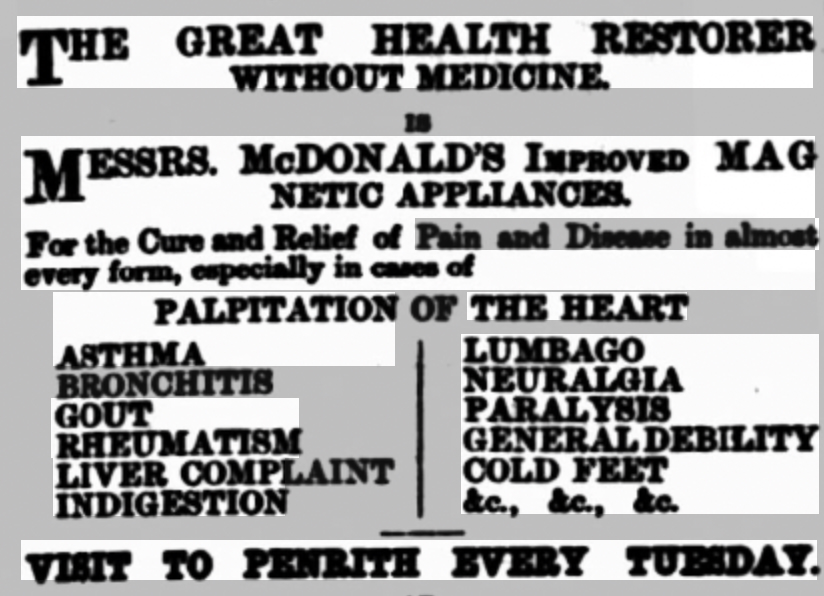
One wonders, in late 1885/early 1886, what John Hogarth’s wife thought of a newspaper advertisement for the Messrs MacDonalds’ Improved Magnetic Appliances.
Messrs MacDonalds’ Improved Magnetic Appliances
Whoever the Messrs MacDonald were, they claimed their appliances were for:
‘the cure and relief of pain in disease in almost every form’.
They could help you with:
‘palpitation of the heart, asthma, bronchitis, gout, rheumatism, liver complaints, indigestion, lumbago, neuralgia, paralysis, general debility, cold feet, &c, &c, &c’
You could buy them direct from Mr Stubbs’ Grocer and Meal Dealer, in Market, Place, Richmond (Yorkshire). Where the MacDonalds’ manager would give you a free consultation (from 10.30am to 2.30pm on Saturdays).
Or from the ‘permanent address’ of 10 Duke Street, Darlington, where the free consultations ran from 10am to 7pm every day.
They also had premises at 37 Roper Street, Whitehaven and sold through Tom Marr’s grocery shop at 10 Castlegate, Penrith.
Or you could buy a magnetic appliance by post, and have it sent postage-free anywhere in the UK. The ad says it’s important to enclose your waist measurement. Oddly, perhaps, it doesn’t say what the price is.
Great faith in magnetic appliances
Just as firms today ask customers to review their purchases, so firms in the 1880s sought customer endorsements to back up their claims.
The advert for Messrs MacDonalds’ Improved Magnetic Appliances is endorsed by letters from Shropshire, Lancashire – and several from Cumberland and Westmorland.
The Cumbrian endorsements
I’m not going to list every Cumbrian who endorsed the magnetic appliances, as there a lot of them, across time and publications.
John Crosby, a farmer of Breaks Hall, Appleby, had derived great benefit from wearing an appliance for rheumatism. While ‘Mrs C’ had found the Magnetic Belt and Lung and Nerve Invigorator had relieved her liver complaint.
Thomas Blackburn, of 95 Ennerdale Road, Cleator Moor, had been using an appliance for nine months and was now able to enjoy and digest his food, after six years of suffering.
William Hewitson, a farmer from Bridekirk, near Cockermouth, was now back at work after two years of being unable to follow his employment.
And William Eubank (sic) of Hackthorpe, a shepherd at Lowther Castle, wouldn’t be without his Best Belt for any money, as it had ended all pain from his rheumatism.
Those are all pretty tame. I mean, in terms of telling the world about your medical issues (the actual efficacy of the products is another matter altogether).
Others to back the product include: Thomas Moore of Blennerhasset (gardener to Sir Wilfred Lawson of Brayton Hall); Mrs M Brown, of Rose Cottage, Nethertown, Maryport; T Chambers of Christian Street, Harrington; and; Isaac Huggins, of the Sun Hotel, Crosby Ravensworth, who said his little daughter’s bronchitis had been cured by the Lung and Nerve Invigorator.
And then we come to John Hogarth, of Knowe Farm, Plumpton, and to; John Airey, of Scales Farm Threlkeld, and to; Robert Bell, another farmer, of Ellercow, near Hunsonby.
John Airey’s endorsement
‘My wife was a great sufferer for number of years from Indigestion and General Weakness. The attacks sometimes were so severe she confined her bed for together…’
But then the Aireys decided to give the best Belt Lung Nerve Invigorator a trial, and they were delighted with the result.
‘My wife is better in every way, eats well, sleeps well, is better fitted for her household duties…’
Robert Bell’s endorsement
‘My wife suffered very much for long time back from Bronchitis and other pains that at times she could scarcely walk about with difficulty breathe at all;
‘in fact she became almost useless in looking after household affairs..’
Luckily, she got a Belt and Lung Invigorator, she ‘became greatly benefited and present free from those excruciating pains’.
Robert Bell was glad such a valuable invention had been discovered.
John Hogarth’s endorsement
Finally, we come to John Hogarth. Not just patronising about his wife’s ‘place’ in life, but also sharing details I’m sure she’d rather have kept private.
In fact, I discovered the advert in the first place after taking photos in St John’s Churchyard, Plumpton, and looking doing a search on some of the names.
‘My wife strongly was recommended about three years ago to try your Magnetic Belt and Nerve Invigorator.
‘At that time she had loss of appetite, lifting wind from stomach, palpitation of heart and great weariness and often a depressed feeling for two years before…
‘but trying your valuable appliances she soon received great benefit and now can eat well and attend all her household duties and is a new woman.’
The serious side
I hope any descendants reading this aren’t offended by the above, because there is a sad side. Which is, of course, that the Messrs MacDonalds’ Improved Magnetic Appliances were trading on people’s desperation for cures. And any ‘benefits’ were likely just a placebo effect.
I’m not going to go into the history of this pseudo-science, but the idea that ‘magnetic forces’ could cure ailments first popped up in ancient Greece and has continued to do so since. While scientists who’ve investigated have never found any evidence it works.
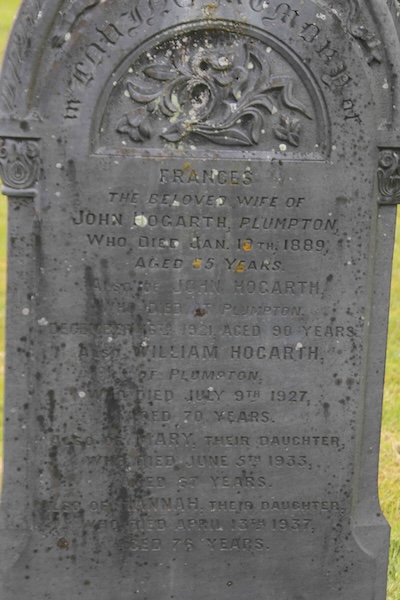
Sadly, the Plumpton gravestone shows that Frances Hogarth died in January 1889, aged 55.
The local papers reported that she had been ‘ailing for some time’ but had been cheerful when she went for a short walk. On her return, she collapsed and died, it was thought from heart disease. Which seems to fit her symptoms from the advert three years earlier.
In 1881, Robert Bell of Ellercow is on the census as 49, with a wife called Rachel, who is 48.
In 1891, Robert was 56 and his wife was Ann just 35. They had a three month old child.
A Rachel Bell died in the spring of 1887, aged 52, which doesn’t fit being 48 six years earlier. But then Robert only aged seven years in ten (possibly because his new wife was so much younger). Given that Robert did have a new wife and baby by 1891, it would seem his first wife, too, hadn’t received that much relief from the ‘belt and lung invigorator’.
In the case of the Crosbys of Breaks Hall, ‘Mrs C’ (Mary) is on the 1891 census, aged 64. But her husband John had died in May 1890, ‘having been in failing health for some time.’
John Airey, of Scales, AND his wife Sarah, were on the 1891 census, aged 56 and 54.
William Ewbank was 54 and an ag lab, no longer a shepherd.
I couldn’t find Thomas Blackburn.
In 1890, the Darlington main address of the Macdonalds was registered to a John Hindson, timber merchant.
The best that can be said about the Messrs MacDonalds’ Improved Magnetic Appliances is that hopefully they didn’t do any harm to users.
And that in 1885/86, there was probably nothing better on the market those users could have taken to alleviate or cure their illnesses or conditions.