
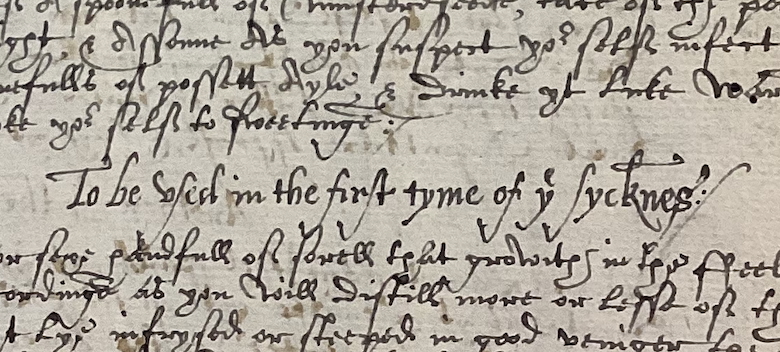
In 1597, plague swept across Cumberland and Westmorland. Some of it is well-recorded, but in parishes like Greystoke, you have to read between the lines.
1597 plague
The plague of 1597/1598 may be less well-known than ‘The Great Plague of 1665/1666.’ But that’s perhaps because the latter was a disaster for London, and was ended, pretty much, by the equally famous 1666 Fire of London.
But for folk in old Cumberland and Westmorland, the plague of 1597/1598 was far more consequential.
In Penrith, for example, it killed around one third of the population.
But it didn’t ‘just’ affect Penrith.
A sore plague
1597; “a sore plague in Richmond, Kendal, Penrith, Carlisle, Appleby, and other places”.
So reads the summary on Cascat of the early parish registers of St Andrew’s, Penrith.
Holme Cultram parish register likewise includes ‘plague entries’ for 1595-97.
And records for Carlisle include accounts of money received for relief of those sick of the plague of 1597-1598. And sums disbursed to those in need – even if you survived the epidemic, the effects of losing family members and on the city as a whole losing key people (butchers, bakers and so on) must have been terrible.
Alms, precautions and ‘remedies’
The Carlisle records are mostly in Elizabethan handwriting and run to at least 16 pages. Which I’m not going to attempt to transcribe for this post!
But it’s fascinating to ‘dip in’, as they also include: pages on ‘Necessary precautions’, and; pages on ‘remedies’.
There’s a section on:
Time of contineuance a parte from common assemblies
IE quarantine.
And one on:
Infected clothes.
The ‘remedies’ would be well worth transcribing, but again they run to several pages of Elizabethan scrawl.
The headings are easy to read and include:
- What ys to be donne when ther is anye rysinge or swellinge in any parte
- Medicine to be used in ordnerye dyett
- To be used in the first tyme of ye sycknes
- Outwarde medicines for to be aplyed to the sores
- Another exclente medicine to ripen and bringe oute the sores.
One word that jumps out from all these treatments is ‘butter’.
While there is a long section on:
Another soveraigne remedye that ys distilled water.
A section headed ‘‘an excellent medicine made without charge’
looks to start:
‘Take of the powder of good barberries the h- taken from them…’
To create something to be drunk by the spoonful.
1597 plague: What caused it?
An abstract for one learned article includes:
The details of the epidemics and the location and the climate of these widely separated small market towns show that bubonic plague was not the causative agent, and the possibility that anthrax was responsible for the drastic mortality is briefly considered. Source:
The Carlisle references to ‘rysinges and swellinges’ and ‘sores’ might fit anthrax. I doubt any infusion of barberries was much help either way.
1597 plague in Greystoke?
While looking through the Greystoke parish records, I was initially surprised to see a sudden spike in burials.
I was looking for entries relevant to my family, and not thinking about wider matters.
But it jumped out at me that in 1596, there were a lot of ‘pore children’ buried – with several of them listed at orphans.
Infant mortality wasn’t, sadly, a big surprise. But for three sets of parents to have died before a child, who then also died… something had to be ‘going on’ there.
A quick count for 1596 showed 45 burials in Greystoke parish.
That was about par for the course, compared to 1593 and 1594.
(In 1595, there were 14 – but in just the first four months, as eight months of the records are missing)
But they tended to be spread out through the whole year.
March 19, 1596 (the end of the year, under the old calendar), saw FIVE burials on the same day. There had been four on March 12 and four on March 13.
THAT had me checking the dates of the Penrith etc plague.
Some other disease?
The Penrith plague started in September 1597.
So in Greystoke parish, what had taken Thomas Banke, ‘a poore childe,’ whose parents John Banke of Berrier and his wife were ‘lait deceased’? Thomas was buried on January 31, 1596 (end of the year again); his father had been buried on January 12. Thomas’ mother Grace had been buried on January 17.
Orphans Isabell Bristowe and Janet Bristowe were buried on February 24 and 26, respectively. Jane Bristowe was buried on July 7 (‘at night’). I couldn’t work out their parents.
A nameless ‘poor child, fatherless and motherless of one Charles Cannon, lait deceased’ was buried on March 8.
Charles Cannon had been buried on February 19, his wife Margaret on February 15.
Three families wiped out by unrecorded disease isn’t an epidemic, but it is unusual to see in the same year in one parish register.
1597 Greystoke
In 1597, the vicar of Greystoke oversaw 154 burials.
Remember, the average was 45 a year.
Meanwhile, Robert Edmundson-Smyth and Agnes Grave, a widow from Hutton John, were married at home, ‘the woman lying sick in her bed’.
However, it isn’t until November 1598 that there is any mention of the plague (at least in the 1911 transcription of the registers).:
Buried November 14, Margaret, child of John Sle of Hutton John, ‘which child was suspected to dye of the plague’.
That year, the deaths had dropped to a more familiar level: 49 burials.
In 1599, there were 39 burials, and in 1600, just 28 (before it rose back up into the 40s in 1601).
So…?
So was the spike in deaths in Greystoke in 1597 unrelated to the plague? Sheer coincidence that the level was more than three times the ‘usual’ figure?
It doesn’t seem to have been many whole families wiped out in 1597 (though three is, of course, tragic). And ‘the plague’ was mentioned in 1598 but not before.
But 20 burials in Greystoke in September 1597; 20 in October (the two worst months). Against three burials in each of those months in 1593, and three and five in those months in 1594…
Update:
There is now a chapter on the 1597 plague in my book The Story of the Border Grahams.