
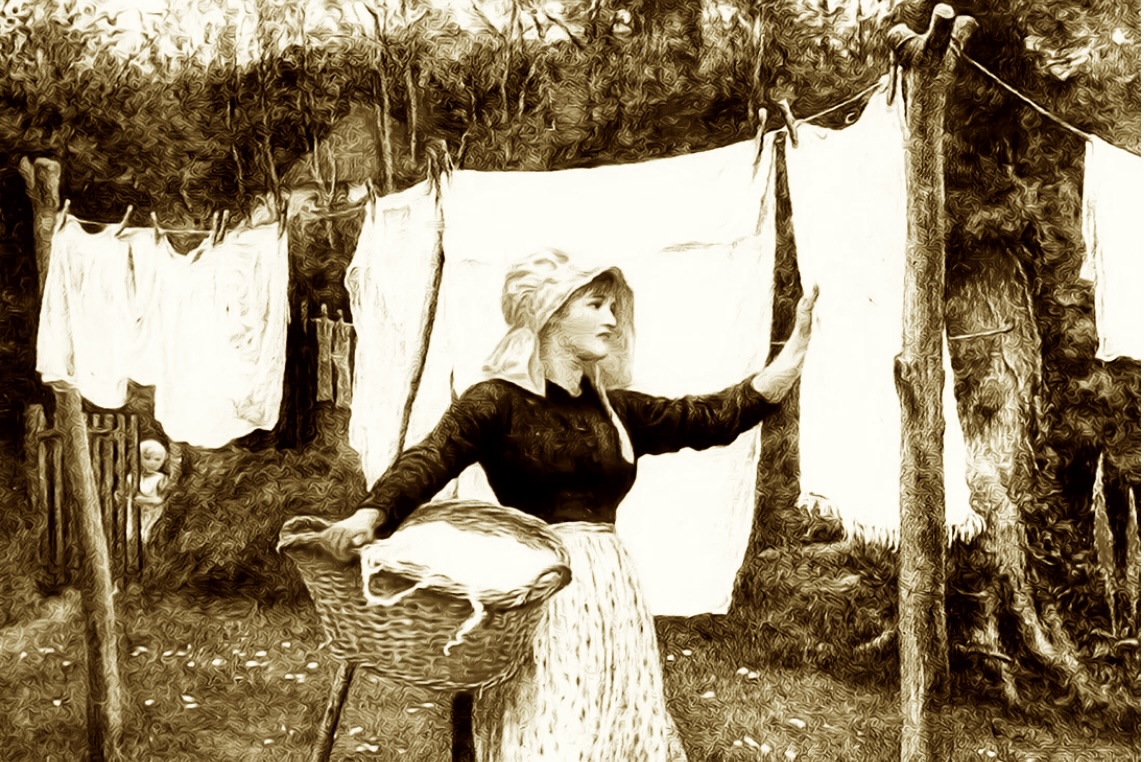
Spring cleaning and genial breath…
SPRING. Winter, the season of frost and snow, of dark nights and of gloomy days, disappears before the warm and genial breath of spring.
The country changes its cold and barren look for a coating of bright green… signs of life and vigour are shown in bursting buds…
Well, quite. The above is from the Lakes Chronicle and Reporter, of March 4, 1887. And contains what was apparently a cliché in those days.
It was a new one on me, but ‘the genial breath of spring’ crops up in publications from The People’s Friend to the Pontypool Free Press in the later decades of the 19th Century.
Today is the first day of meteorological spring (in the UK). But as it had rained some part of pretty much every day of 2026 so far, the gardens are too saturated to contemplate post-winter tidying up etc. So thoughts turn to that other perennial topic of the season: spring cleaning.
Turns out not much is new under the sun.
Spring cleaning and decluttering
In 1865, Wells’ Marine Stores was urging readers of the Kendal Mercury: ‘Let nothing be wasted.’
Any housekeeper ‘or others’ decluttering while doing their spring cleaning were told ‘G.W.’ welcomed ‘anything useless, such as ladies’ and gentlemen’s cast-off clothing.’
They were also interested in such items as waste paper, books, rags, bones, whalebone, hare and rabbit skins, and horse hair, as well as old metals. Not quite the items listed in today’s ‘we buy your stuff’ adverts, but the same principal.
GW’s business address was Angel Yard, Highgate, Kendal. The only decent match on the census is a George Wells, ‘broker and book dealer’, who was 36 in 1871 and living in Finkle Street with a wife, several children, and a general servant.
Beware of imitations
Kendal folk were, around that time, being advised to use Hudson’s Extract of Soap, for spring cleaning (Beware of imitations). While all those who wished to see a brilliant polish on their furniture:
‘ought to use Holme’s Furniture Cream. Superior to any other preparation of the kind in the North of England’.
This was being marketed by John Holme, a stationer and druggist.
A women’s work
The Lakes Chronicle and Reporter, in 1880 noted, under the heading Spring Cleaning, that:
‘whilst their husbands are boiling over with political enthusiasm, the good housewives of the Lake District are in the midst of their annual preparations for the reception of visitors.’
The writer mused on the topic of ‘dirt’ being ‘misplaced matter’:
‘At this season of the year they seem specially alive to the conviction, and to be seized with a frenzied desire to get rid of the misplaced matter, and send it to its own place, wherever that may be.’
The author – someone called Muriel – was not surprised that some women weren’t keen on spring cleaning, but had found:
‘some people who seemed to take a fierce kind of delight in periodically turning everything upside down, and making everybody in the house as uncomfortable as possible.’
Muriel then went off on a random tangent of thought about how ‘some women I know’ had a keen eye for dust, but no grasp of wit: ‘the keenest shafts of satire (would be) levelled at them in vain’. Before giving readers a way to cook Brussels sprouts.
Spring cleaning tries the temper
In 1887, it was ‘Jennie’ who was writing on the topic in The Reporter, in the form of a ‘letter’.
‘Spring cleaning… isn’t there a terror in the very name.
‘Visions of uncarpeted stairs, curtainless windows, beds without hangings, folding steps left standing just while everybody will knock them down, hammer and nail thrown down just where everyone is bound to tread on them, confusion reigning supreme, and a smell like a workhouse pervading the atmosphere.’
Her particular sympathies were for those women who only had one servant and ‘a slip of a girl’ to help them. For them:
‘spring-cleaning means many a trial of temper and much discipline of soul.’
At least Henry Wilson Herd, chemist, stocked Superior Furniture Cream at six pence and one shilling a bottle in his Ambleside pharmacy. When applied according to directions, it would be:
‘found to produce a bright surface with half the usual amount of labour.’
Henry, in 1881, was living in Ambleside with his wife, two very young children, an apprentice, a ‘slip of a girl’ domestic servant (aged 14) and his mother. The women of the house were probably glad if the Superior cream lived up to its promise.
Robbing spring cleaning of its horror
The Lakes Herald, in 1888, had the sort of advice that turns up in my news feed today about de-cluttering and so on.
It says planning is key to ‘robbing spring cleaning of its horror’.
Draw up a plan of action: go through the house from top to bottom:
‘and empty, scrub out, and tidy all drawers, boxes, cupboards, presses, and chests.’
Then tackle ‘the larders, kitchens and store cupboards’. Getting rid of anything no longer required.
‘When energetic action can no longer be dispensed with – and not till then – have the stair carpets up, take the bull by the horns, press all hands into the service, and get through as speedily as possible.’
Along the way, only do what you can, then:
‘Having finished for the day, try to banish the subject from the thoughts as well as from conversation. If it can be set aside completely it will not be a strain on the nerves.’
Baking soda and vinegar
According to influencers and news outlets that pick up their hints, the answer to all domestic problems today is to use either baking soda or white vinegar. Or both.
In 1888, it was turpentine that was being touted.
All I can say is that nothing in this post is a recommendation endorsed by Cumbrian Characters!
Turps can be used to clean oil-based paint off brushes, but the smell is horrible, should only be used somewhere well-ventilated, and you’d have to be mad to ingest it or rub it on your feet.
But back in 1888, it was claimed that it was good for:
Burns; corns; rheumatism and sore throats; convulsions or fits; preventing moths in drawers; keeping ants and bugs from closets and storerooms; killing bed bugs; adding to the suds on laundry days, and (oh yeah) cleaning paint.
Spring hasn’t sprung
The start of meteorological spring is too early to be washing curtains or cleaning carpets. After just the regular weekly housework yesterday, the thought of ‘emptying, scrubbing out and tidying all drawers’ really did sound like ‘a trial of temper.’
In a few weeks’ time such things will have to be contemplated. But for now, I’m with Mole from Kenneth Grahame’s ‘Wind in the Willows’:
‘Hang spring-cleaning!’